
How to Run Open-Source AI Models: Own Your AI Stack with OpenRouter, GLM-5.2, DeepSeek, Qwen & Kimi (2026 Guide)
Every way to run open-source AI models — OpenRouter, cloud, or self-hosted — scored by budget, privacy, and skill. GLM-5.2, DeepSeek, Qwen & Kimi.

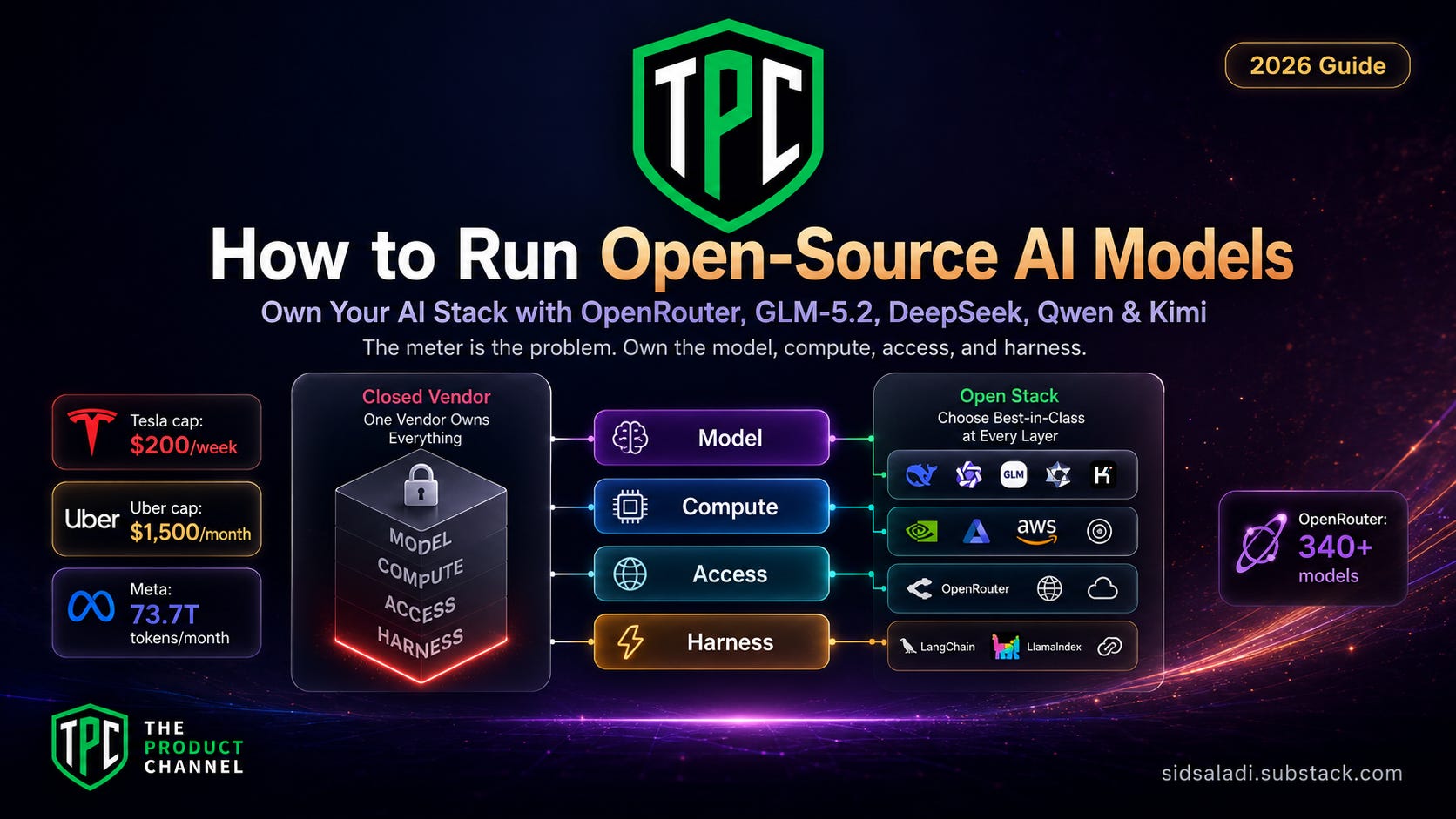
Tesla just capped what its engineers can spend on outside AI tools at $200 a week. The cap kicked in July 6 — the day I'm writing this. Before that, some engineers were burning through thousands of dollars of tokens a week.
Uber capped its people at $1,500 a month per coding tool after blowing through its entire 2026 AI budget by April.
Meta sent a memo to about 6,000 employees because its internal AI bill was "approaching billions of dollars" this year. Staff had chewed through 73.7 trillion tokens in a single month.
There was an internal leaderboard for it. Someone named it "Claudeonomics."
Here's the truth nobody at these companies wants to say out loud: the meter is the problem. When your intelligence is metered by someone else, your costs are set by someone else — and so is your access.
This guide is about taking that back.
The Product Channel by Sid Saladi is a reader-supported publication. Subscribing is free and gets you 100+ deep dives on shipping and scaling with AI. Consider a free or paid subscription.
The One Idea That Runs This Whole Guide
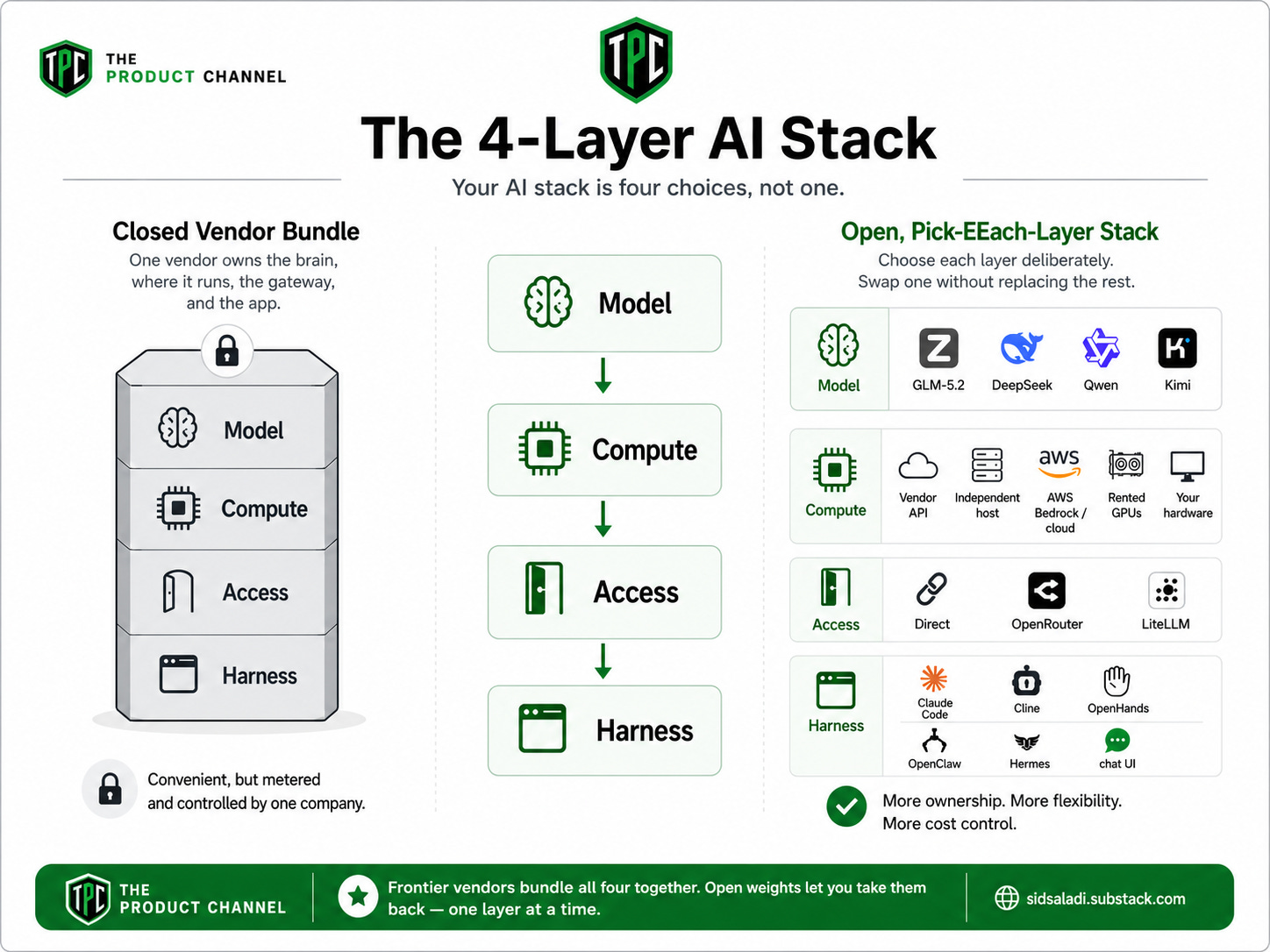
Your AI stack is four choices, not one:
The model — which brain (Claude, GPT… or open weights like GLM-5.2)
The compute — where it physically runs, and who holds your data while it does
The access layer — the router or gateway between you and that compute
The harness — the app that actually operates the model (Claude Code, an agent, a chat box)
Frontier vendors bundle all four together and hand you the package. That's convenient. It's also why you get a surprise bill and a "we're sunsetting your plan" email.
Open weights let you take those four choices back — one layer at a time.
That's the mental model. I'm going to repeat it, because it's the thing to remember when the acronyms pile up. You're not "switching to Chinese AI." You're deciding, deliberately, who owns each layer of your stack.
Let me show you why this suddenly matters — and then every path, cheapest to most sovereign. If you've read my AI Model Selection Guide: Which Tool for Which Task, think of this as the infrastructure sequel — same question, one layer deeper.
The Truth About How Most People Buy AI
Most people buy AI the way they buy electricity. You plug into one provider, you trust the meter, you pay whatever the bill says.
That worked when there was no other option. It's a bad idea now, for two reasons.
Reason one: the meter is expensive and unpredictable. See Tesla, Uber, Meta above. Frontier tokens are priced for frontier margins.
Reason two — the one people miss — your vendor is becoming your competitor.
Look at what Anthropic shipped in about eleven months: Claude Code, Claude for Chrome, Claude Cowork, Claude Design, a Slack teammate called Claude Tag, and Claude Science. (If you half-remember them launching something like "code research" — that's Claude Science, from June 30.)
That's not a model company anymore. That's a company building products in your category, on top of the very model you're renting from them.
And they can turn off the tap. In June 2025, Anthropic cut Windsurf's direct Claude access with less than five days' notice while a rival was in talks to buy it. In August 2025, Anthropic revoked OpenAI's Claude access for a terms violation.
Microsoft just moved thousands of internal engineers off Claude Code onto its own tool. Anthropic even ran a test pulling Claude Code from the $20 Pro plan (it reversed within about a day after backlash).
If your vendor can cut off OpenAI, it can cut off you.
None of this means "don't use Claude." I use Claude every day. It means don't let one vendor own all four layers of your stack by default. Own them on purpose.
The Alternative Actually Arrived
For years, "just use open models" meant accepting a worse brain to get freedom. That trade is basically gone.
In mid-June 2026, Z.ai (Zhipu) released GLM-5.2. The important facts:
License: MIT. You can download the weights, run them, modify them, ship them commercially. No permission needed.
Context: 1 million tokens. Enough to hand it an entire codebase.
Capability: It beats GPT-5.5 on several coding benchmarks (SWE-bench Pro: 62.1 vs 58.6) and lands within a hair of Claude Opus 4.8 on others. It's not better across the board — it trails the frontier on some reasoning tests — but for real work it's frontier-adjacent.
Price: about one-sixth of GPT-5.5 on output. Roughly $1.40 in / $4.40 out per million tokens, versus GPT-5.5's $5 / $30.
The Z.ai founder went further and forecast open-weight Fable-class capability arriving "sooner than Q1 2027." Treat that as a founder's bet, not a promise. But the direction is clear.
And GLM-5.2 isn't alone. DeepSeek V4, Qwen 3.5, and Kimi K2.6 are all strong, all openly licensed, all running the same playbook. Pick GLM-5.2 as your hero here; the paths below work for any of them.
So the old excuse — "open models aren't good enough" — is dead. Which means the only real question left is: how do you actually run one? Four layers. Let's build.
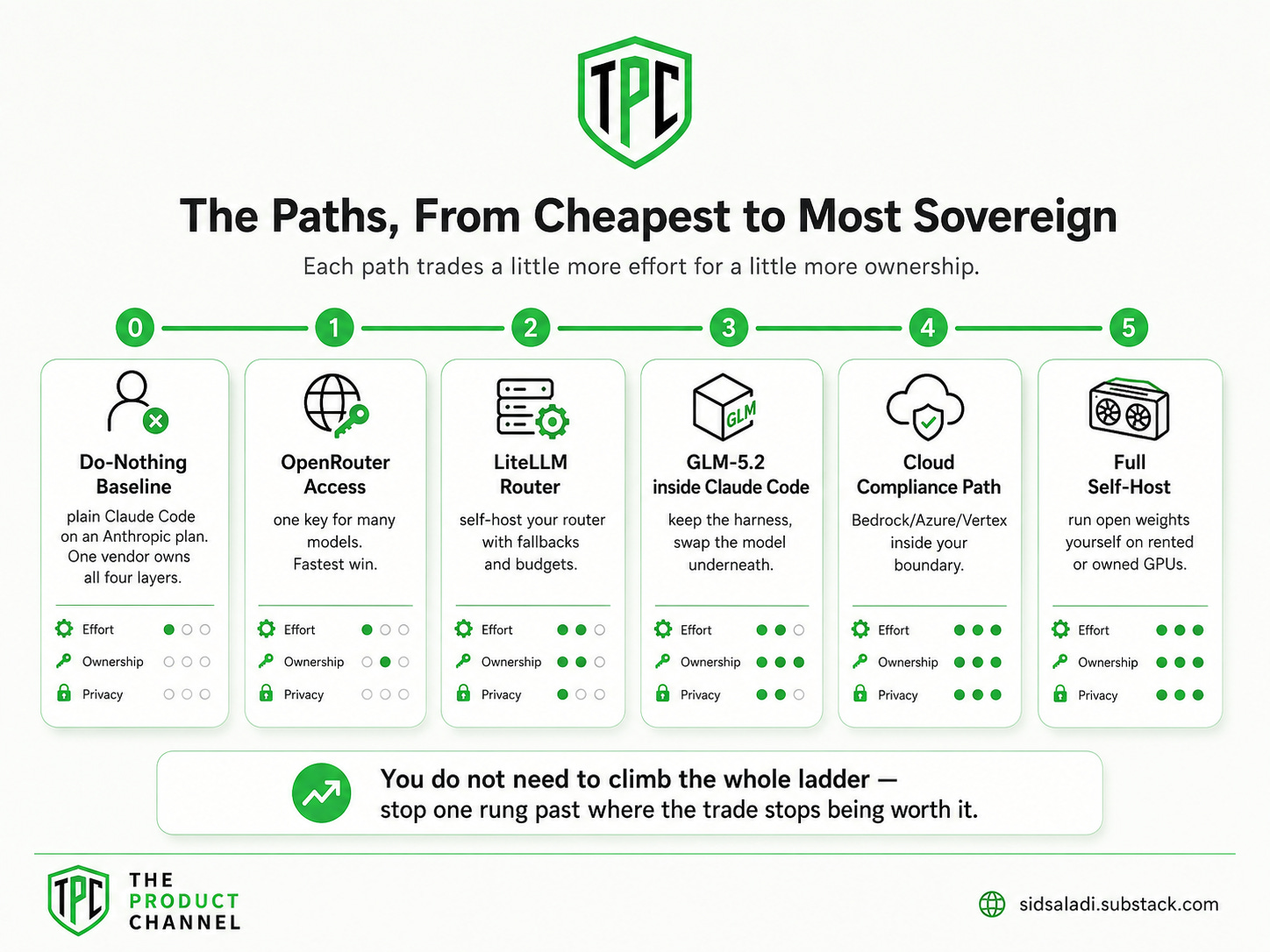
Path 0: The Do-Nothing Baseline (Just Use Claude Code)
Keep reading with a 7-day free trial
Subscribe to The Product Channel By Sid Saladi to keep reading this post and get 7 days of free access to the full post archives.