
Lovable to Claude Code 101: The Migration Guide
Lovable still wins for 0 to 1. But Lovable Cloud bills add up the moment your project starts to matter. Here is the exact migration to Claude Code + Supabase + Cloudflare — including the master prompt.


Lovable shipped my first 4 apps in a weekend. Then Lovable Cloud burned 80% of my credits in 9 days serving 47 users. Claude Code now runs the same apps for $20/month.
I have built 6 apps on Lovable. I love it. It is still the fastest “I have an idea on a napkin → live URL my mom can open” tool I have ever used — I reviewed it honestly in my full vibe-coding journey.
But last month I watched Happy Baby Monitor — a tiny side project with under 100 active users — eat through a $25 Lovable Cloud allowance in a week and start asking me to top up at credit-pack prices. The traffic was a rounding error. The bill was not.
That is when I switched the project to Claude Code + Supabase free tier. Same app. Same Stripe. Same users. One sixth of the cost.
If you are in the same spot — you built on Lovable, the idea is working, the bill is climbing, and you have a little technical confidence (or a Claude Code subscription you are already paying for) — this guide is the one I wish I had when I started migrating.
I will show you when Lovable still wins, when Claude Code is the obvious move, the exact migration steps for a real Lovable project, and a single master prompt you can paste into Claude Code that will walk you through the whole thing step by step.
The steps below are detailed enough that someone who has never touched a terminal can follow them. If you are a more experienced dev, skim — the per-step “Verify” lines are the only parts you need.
The Product Channel publishes guides like this every week. Over 100 in the archive. 10 seconds, free:
PART 1: THE HONEST COMPARISON
Before I tell you to migrate, you should understand what you are giving up. Lovable is not the villain in this story. It is a great tool that became expensive at exactly the moment your project starts to matter.
What Lovable Does Better Than Anything Else
Let me say this clearly so the rest of the guide makes sense: for going from zero to one, Lovable is still the best tool I have used.
That includes Bolt, v0, Replit Agent, Cursor, Windsurf, and Claude Code itself. If you have an idea today and you want a working URL by tonight that handles auth, a database, and a paywall — open lovable.dev. Do not read the rest of this newsletter yet.
Here is what Lovable still does better than Claude Code:
Zero environment setup. No Node, no terminal, no Git, no Vercel, no env vars. You type. It deploys. You share a link.
Visual editing without code. Click an element on the page, type “make this button green and rounder,” ship.
Built-in preview for non-technical co-founders. Your designer can leave comments on the live preview without learning a single command.
Templates that actually compile. v0 and Bolt break more often than Lovable does for me on the first prompt.
One-button publish to a real URL. No DNS dance, no SSL setup, no build pipeline. Lovable handles it.
If your only goal is “I want to show this to 10 people and see if anyone cares,” Lovable wins. The first $25 of your project should almost always live there. I am not going to argue against it — I walk through exactly when each vibe-coding tool wins in Vibe Coding 2.0.
Where Lovable Starts to Hurt
The pain begins when the project survives the napkin stage. Three specific things changed in the last year, and together they reshape the economics for anyone past the first prototype.
1. Lovable Cloud replaced bring-your-own backend as the default.
When I built my first 3 Lovable apps, the recommended pattern was Lovable for the frontend + your own Supabase project for the backend. Supabase had a free tier so generous it felt like a typo. You wired up auth, Postgres, storage, and edge functions, and your monthly bill stayed at zero until you crossed real scale.
Today the default is Lovable Cloud — a Lovable-managed backend that bills by the message and the megabyte. You can still bring your own Supabase. The integration just is not the default anymore, and most new users do not know it is an option. (
2. The credit math gets ugly fast once you are iterating.
In Plan mode, one chat message costs about 1 credit. In Build/Agent mode, a real change (”add Stripe checkout”) often costs 1.5 credits or more.
That sounds fine until you do the math.
Free plan: 5 daily credits, capped at 30 per month.
Pro plan: $25/month, 100 monthly credits.
Business plan: $50/month.
100 credits = roughly 100 small chat messages OR ~65 real build messages. If you are actively iterating on a feature, you can burn that in a single afternoon.
3. Lovable Cloud’s free allowance does not cover real traffic.
Every workspace currently gets $25/month of Cloud hosting and $1/month of in-app AI free. That sounds like it should cover a small app.
It does not — for two reasons:
AI features are billed by token use. Any AI feature inside your app (a chatbot, an embedding search, a summary button) eats your AI budget per call.
Cloud egress and database calls add up under spiky traffic. A single viral post sending 500 visitors at once can chew through the $25 cushion in hours.
This is the bill that surprised me on Happy Baby Monitor. Under 100 users, real but small traffic, and Lovable kept asking for top-ups at credit-pack prices.
What the Rest of the Internet Is Saying
I am not the only one running into this. The pattern shows up across recent Lovable reviews:
Credit burn is the #1 complaint. Multiple breakdowns describe “credits running out mid-feature” as the most common frustration on the Pro plan.
Plan mode → Agent mode confusion costs real money. Switching modes without realizing it can 3x the cost of the same conversation.
The Free tier’s 30 credit cap is not enough for any real project. It works for “tweak a landing page once a week.” It does not work for active development.
None of this makes Lovable a bad product. It makes Lovable a wrong fit for the specific moment when your project has users but no revenue yet — which is exactly the moment when most of my apps need to survive.
The Supabase Free Tier vs. Lovable Cloud (Real Numbers)
Here is the part of the math that flipped everything for me. Same backend features, two different bills.
Supabase Free Tier (May 2026):
500 MB Postgres database — fits ~500,000 rows of typical app data
5 GB egress/month — covers tens of thousands of API calls
1 GB file storage
50,000 monthly active auth users — yes, fifty thousand
500,000 edge function invocations/month
200 concurrent realtime connections
2 active free projects per account
Lovable Cloud Free Allowance (May 2026):
$25/month of Cloud hosting
$1/month of in-app AI
Both billed by use after that, at standard Cloud rates
Here is what that means in plain terms.
The Supabase free tier can host a real production app with 5,000 monthly users and never charge you a cent — I have seen it. The Lovable Cloud allowance covers maybe a few hundred users with light backend use, after which the meter starts spinning.
For Happy Baby Monitor specifically:
Lovable Cloud: ~$45/month at the traffic I was hitting (cloud + AI top-ups)
Supabase free + Claude Code Pro: $20/month total, no usage-based surprises
Same app. Same features. Same users. One-third the cost — and the Claude Code part of the bill stays flat no matter how many users I add (until I hit Supabase paid tier limits, which is a long way off).
Claude Code: Pricing and Reality
So what does Claude Code cost?
Free with Claude.ai account — limited tokens, mostly for tasting
Pro: $20/month — fine for one solo developer on one project
Max 5x: $100/month — heavy use, multiple projects, sweet spot for most builders
Max 20x: $200/month — autonomous multi-hour agent sessions, multiple parallel projects
API: pay-as-you-go — more expensive per token but no monthly minimum
One important honest nuance: there was a brief moment in late April 2026 when Anthropic edited the pricing page to suggest Claude Code was moving to Max-only. They reverted it within hours after the backlash, and as of today Claude Code is still included on the $20/mo Pro plan. But there is a real catch worth knowing: Pro shares rate limits between regular Claude chat and Claude Code, and Claude Code is much more token-intensive than chat. Light users (1–2 focused sessions per day) stay comfortably within Pro. If you are using Claude Code for 2+ hours a day, or running multiple projects in parallel, you will hit limits fast — that is when Max 5x ($100/mo) becomes the real sweet spot.
For someone migrating off Lovable Pro ($25/mo), Claude Code Pro at $20/mo is the direct swap. You give up the visual editor. You gain a coding agent that can refactor your entire app, deploy to any host, and never charge you per build. If you outgrow Pro’s limits within a month or two, Max 5x is still cheaper than Lovable Pro + Lovable Cloud at any real scale.
I run on Max 5x because I have 6 projects in flight. The math still works out cheaper than running them all on Lovable Pro + Lovable Cloud.
When Lovable Still Wins (Be Honest With Yourself)
Lovable is the right tool when:
You have not validated the idea yet. Spending an evening on a Lovable prototype to find out nobody wants it is cheaper than two days in Claude Code.
You cannot install Node, Git, or VS Code on your machine. Or you do not want to. Lovable runs entirely in the browser.
Your co-founder is non-technical and needs to click around and leave feedback.
The whole app fits in 30 prompts of iteration. Build it, ship it, stop touching it.
If any of those apply, do not migrate. Stay on Lovable. Pay the $25.
When Claude Code Wins
Claude Code is the right tool when:
Your project has users and you are still iterating. Every credit you burn on Lovable comes back as a $0 commit in Claude Code.
You want to own your code. Claude Code writes to your local filesystem and your GitHub repo. There is no “platform” that can change pricing on you next quarter.
You want a real backend on a real free tier. Supabase, Neon, Firebase, or your own server — all wire up cleanly to Claude Code without a credit meter.
You want to deploy anywhere. Cloudflare, Vercel, Netlify, Fly, your VPS. Lovable Cloud is the only option on Lovable. Claude Code can ship to any of them in one command.
You are paying for Claude already. If you have Claude Pro or Max for general AI use, Claude Code is included in the same plan. Lovable is a second subscription on top.
The decision rule is this simple: prototype on Lovable, ship and scale on Claude Code.
That is what I do. That is what this guide will help you do.
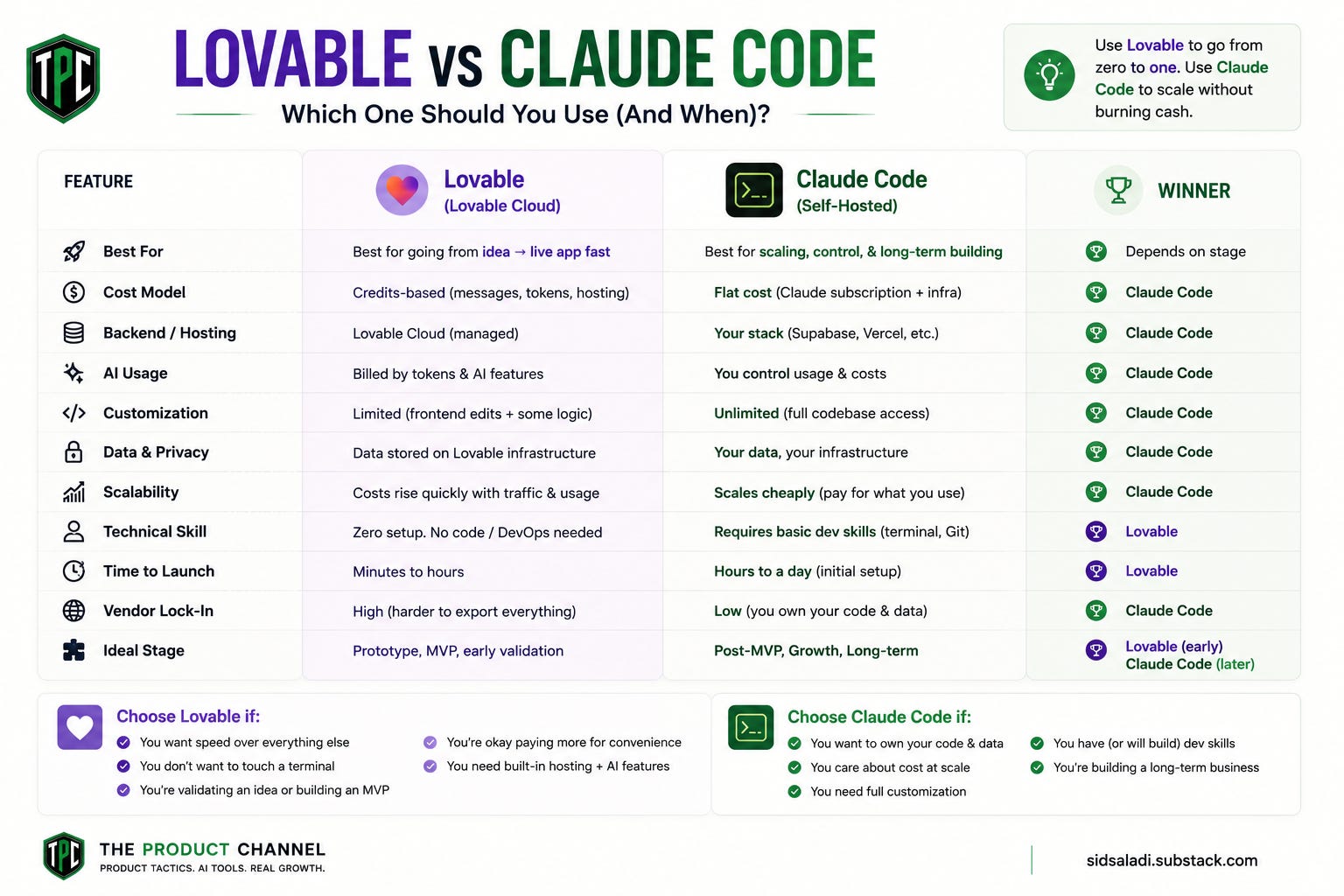
PART 2: THE COMPARISON TABLE
The whole comparison on one screen, since I will reference it through the rest of the guide.
PART 3: THE 9-STEP MIGRATION PLAN
I have done this migration twice now (Happy Baby Monitor + a SaaS prototype called GetPrompts). The playbook below is what worked, in the order it worked.
Time estimate: A small app (≤ 15 routes, single Supabase database, Stripe + auth) takes about 90 minutes the first time, 30 minutes the second time.
Prerequisites:
A Lovable project on the Pro plan (you need GitHub export — this is the one Lovable charge you cannot avoid for the migration itself)
A GitHub account
Node.js installed locally (I will tell you when)
Claude Code installed (instructions in Step 3)
A Cloudflare account (free tier is fine)
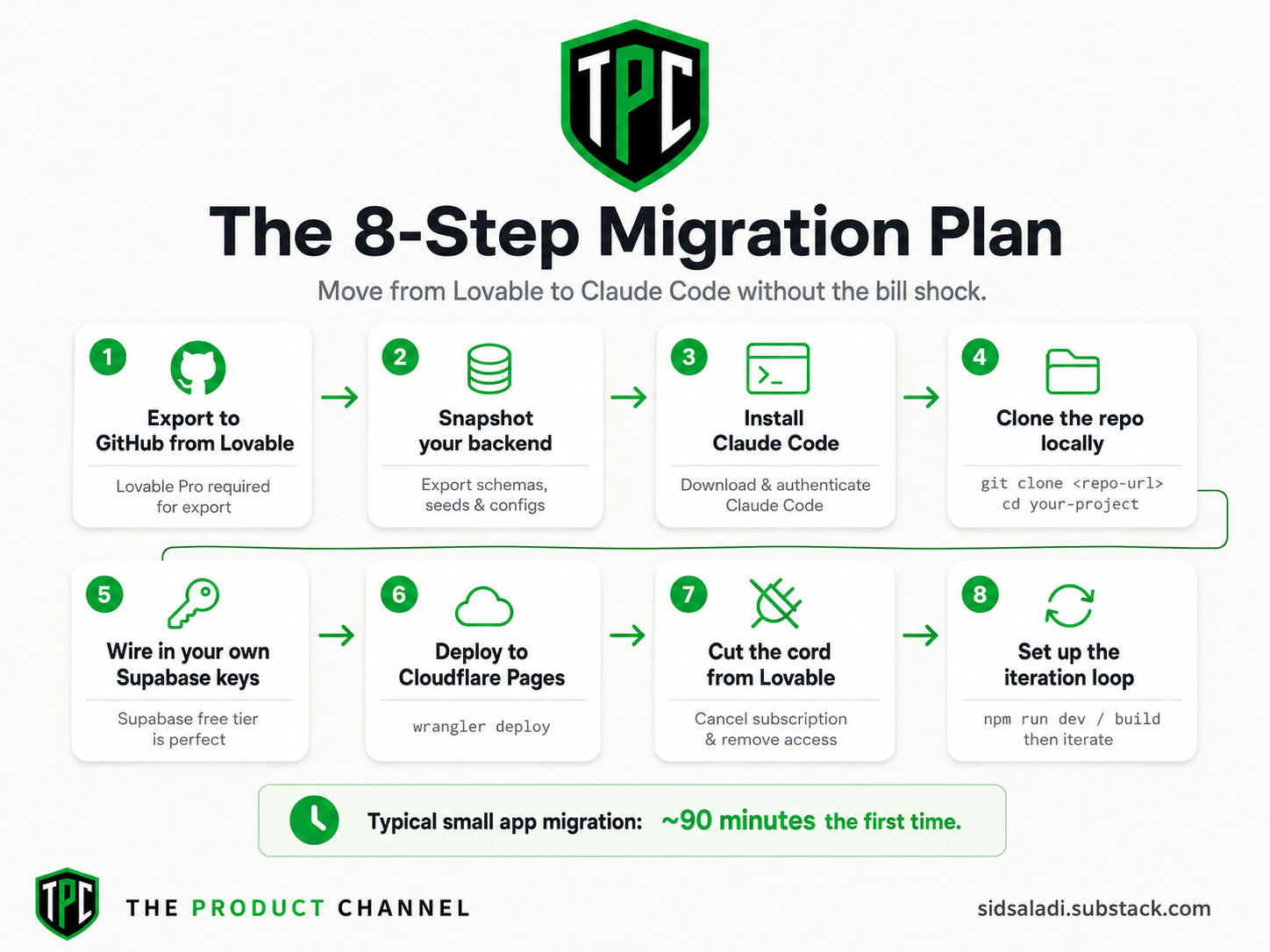
Step 1 — Export to GitHub From Lovable
Time: 5 minutes. Difficulty: Easy.
Keep reading with a 7-day free trial
Subscribe to The Product Channel By Sid Saladi to keep reading this post and get 7 days of free access to the full post archives.