
The Open-Weight Stack: How to Build an AI Setup That Can’t Be Banned

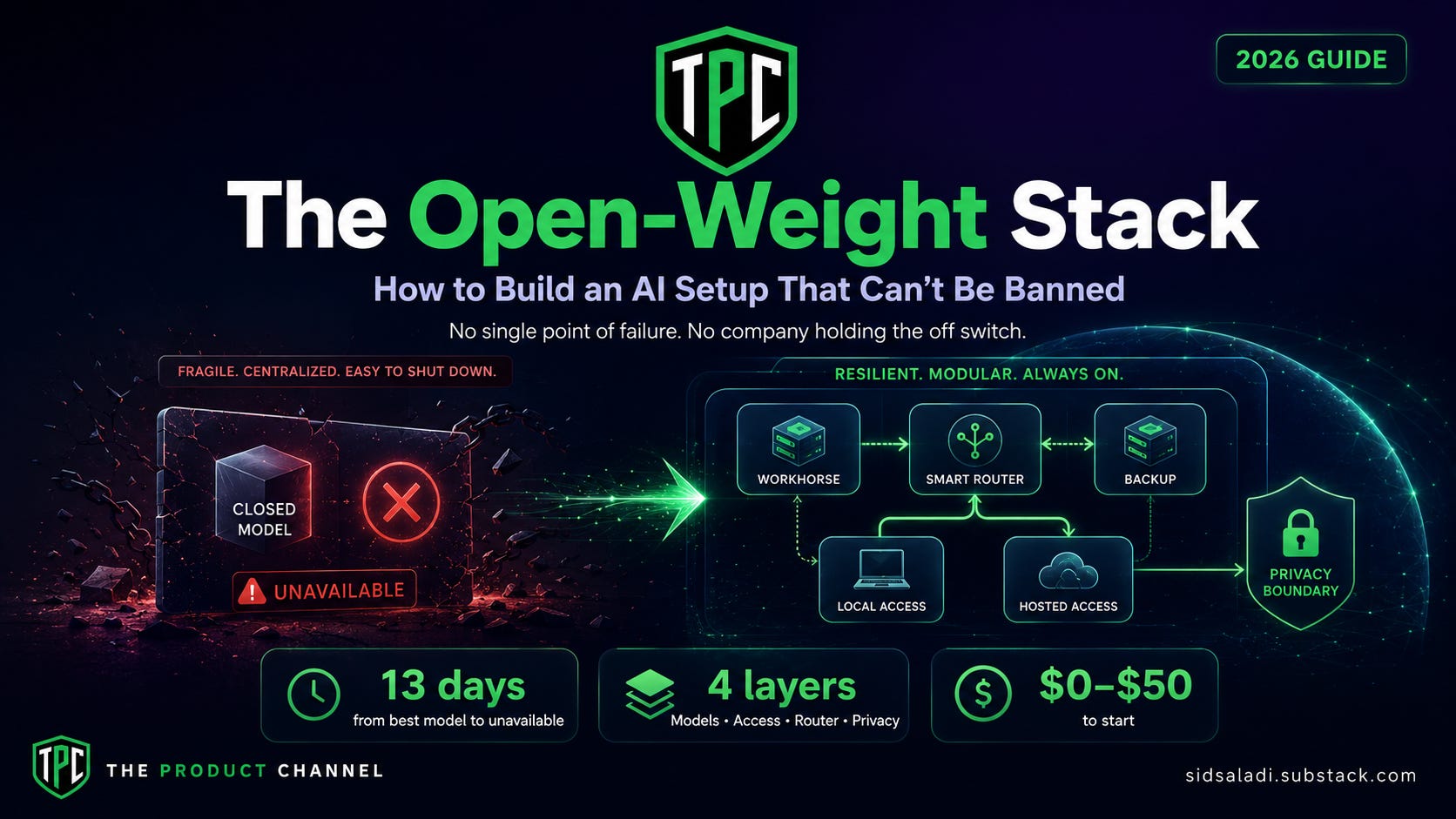
On June 9, two of the most powerful AI models on earth went live. By June 12 they were restricted. By June 22 the free trial was gone too.
That’s 13 days from “best model available” to “you can’t use it.”
If your product, your team, or your weekend side project ran on one model from one company in one country — you just learned how fragile that is.
This playbook fixes that. By the end, you’ll have an AI stack that keeps working even when a model vanishes, a provider goes down, or a new rule lands overnight. No single point of failure. No company holding the off switch.
Let’s build it.
Thanks for reading The Product Channel by Sid Saladi! Subscribing is completely free and gives you access to 100+ free product deep dives, frameworks, and resources.
🧱 Why “Pick the Smartest Model” Became a Liability
For two years, choosing an AI model was simple. You picked the one at the top of the leaderboard. You paid. You shipped.
That logic just broke.
Here’s what happened in June 2026. Anthropic’s two newest models, Fable 5 and Mythos 5, were restricted just days after launch — pulled worldwide.
Then on June 29, The Information reported that Meta told its own engineers to stop freely using Claude Code and OpenAI’s Codex. The fear was distillation — rival outputs leaking into Meta’s Llama training data.
So in one month: one company’s models were restricted from the top, and a tech giant walled off rival tools from the inside.
The pattern is clear. Access is now political. Your model can disappear for reasons that have nothing to do with quality or price. A new rule. A trade fight. A legal worry. A provider outage during your launch.
If you don’t have an answer, you don’t have a stack. You have a dependency.
🔓 What “Open-Weight” Actually Means (Skip the Textbook)
Quick definitions, because the words get thrown around loosely.
Closed model: You send your prompt to a company’s servers. They run it. They send back the answer. You never touch the model itself. Think Claude Opus, GPT-5.5, Gemini 3.1 Pro. If they cut you off, you’re done.
Open-weight model: The company publishes the actual model file. You can download it, run it on your own machine or any cloud you choose, and nobody can take it back. Examples: GLM-5.2, DeepSeek V4, Qwen, Kimi, Llama.
Open-source model: Goes further — weights plus training code plus data, so anyone could rebuild it from scratch. Rare. You usually don’t need this. For builders, open-weight is enough.
Worth clearing up, because it trips people up: online, models like Llama, DeepSeek, and Qwen often get called “open source.” Strictly, they’re not — they release the weights but not the full training data and code, which makes them open-weight. True open-source models (like AI2’s OLMo) are the exception, not the rule.
Here’s the part that matters: once you’ve downloaded an open-weight model, no ban can reach it. A directive can stop a company from serving a model. It can’t claw back a file already sitting on your drive.
That’s the whole idea behind a ban-proof stack. Own the weights, or at least keep an open-weight option warm, so you always have a door that can’t be locked from the outside.
One catch to remember: open-weight is about the file, not the license. Some models let you do anything (MIT, Apache 2.0). Others add rules — user caps, attribution, geography limits. The license matters more than the label. We’ll come back to this.
📊 The 2026 Open-Weight Roster
The big surprise of 2026: open-weight models closed the gap. For coding and agent work, the best open models now sit within a few points of the closed frontier. And many are cheaper by 10x to 100x per token.
Most of the strongest ones come from Chinese labs — Z.ai, DeepSeek, Moonshot, Alibaba, MiniMax. A few come from the West — Meta’s Llama, Google’s Gemma, Mistral, and OpenAI’s own gpt-oss.
Here’s the shortlist worth knowing, with the trade-off each one makes.
Keep reading with a 7-day free trial
Subscribe to The Product Channel By Sid Saladi to keep reading this post and get 7 days of free access to the full post archives.